Community
Community
NEWS
총 971건의 게시물이 있습니다.
There are a total of 971 posts.
-
News
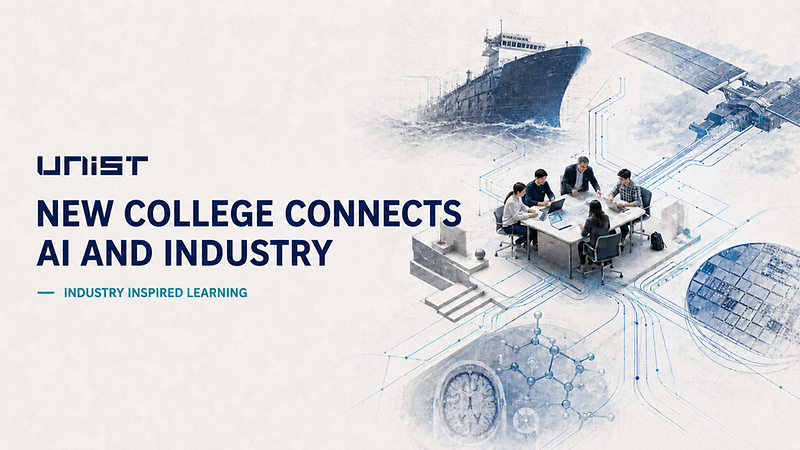
UNIST to Launch College of AI Convergence 신규게시글New college will connect AI education with major industries across Southeast Korea.JooHyeon HeoUNIST will launch its College of AI Convergence (name tentative) in September 2026, bringing education in computing, engineering, AI, and design into a single academic structure shaped by real-world industrial problems. On July 11, the UNIST Board of Directors approved the reorganization of the College of Information and Biotechnology on August 11, 2026. The new structure will apply to undergraduates entering in 2027. The college will encompass six majors, which includes Electrical Engineering, Computer Science and Engineering, Artificial Intelligence, Industrial Engineering, Biomedical Engineering, and Human-Centered Design Engineering. It will also introduce eight interdisciplinary pathways that apply AI to fields, including shipbuilding and maritime engineering, aerospace, defense, materials, semiconductors, and health care. Rather than remain within a single department, students will be able to combine coursework across fields and shape their studies around particular technologies, industries, or career goals. Industry Inspired Learning (IIL) will be a central part of the curriculum. Through the program, companies and research institutes will provide problems and data drawn from their work. Students will examine these challenges with faculty and industry specialists, applying what they learn in class to develop possible solutions. Promising projects may continue as graduate research and, where appropriate, move toward use in industrial settings—an approach UNIST calls Lab-to-Factory. This creates a direct path from undergraduate coursework to advanced research and practical application without treating them as separate stages. The reorganization responds to growing demand for AI expertise in major industries across Southeast Korea. To support the expansion, UNIST will admit an additional 100 undergraduate and 100 graduate students with government funding beginning in 2027. “The College of AI Convergence will take real problems from industry as the starting point for teaching and research, then work to turn the resulting solutions into new technologies,” said UNIST President Chong Rae Park. “By bringing UNIST’s research strengths together with expertise from key industries, we aim to prepare graduates who can lead the practical adoption of AI.”- 2026.08.14
- 658
-
News
UNIST to Advance AI Transformation in Maritime Defense 신규게시글Selected to lead Busan center, supporting AI development for the ROKN and ROKMC.JooHyeon HeoUNIST will serve as a hub for collaboration on defense AI, bringing together military, industry, and academic partners as Korea expands the use of artificial intelligence (AI) across its armed forces. The Graduate School of Artificial Intelligence (AIGS) at UNIST has been selected to lead the Busan center supporting AI development for the Republic of Korea Navy (ROKN) and Marine Corps (ROKMC). The center is part of the Defense AI Talent Development Program, led by the Ministry of National Defense and the Institute of Information & Communications Technology Planning & Evaluation (IITP). The initiative will establish five centers across Korea for joint research using defense data—Yongsan for the Joint Chiefs of Staff (JCS), Yangjae for the ROK Air Force, Pangyo and Daejeon for the ROK Army, and Busan for the ROKN and ROKMC. UNIST, KAIST, Korea University, Seoul National University, and Ajou University will lead the respective centers through 2030. Based in Centum City, the Busan center will develop AI technologies around the operational needs of the Navy and Marine Corps. UNIST researchers will work with military partners, local governments, and defense companies, connecting AI research with the region's maritime and defense industries. Three projects are planned for the first year, including an AI system for military logistics and inventory management; a retrieval-augmented generation (RAG) large language model for military doctrine, manuals, guidelines, and legal cases—as well as Ender's Foundry , a platform for developing AI-based decision-support capabilities for the ROKN. The technologies will be tested and validated in military environments. Jae-Young Sim, Dean of UNIST AIGS, will lead the project. Ten UNIST faculty members will work across five areas: reliable detection, LLMs and ontology, situational analysis and decision-making, safe and trustworthy AI, and on-device AI and hardware technologies. The teams pair Professors Jae-Young Sim and Seungjoon Yang in reliable detection, Professors Youngsoo Jang and Yeon-Chang Lee in LLMs and ontology, Professors Seungyul Han and Hyungho Na in situational analysis and decision-making, Professors Sung Whan Yoon and Saerom Park in safe and trustworthy AI, and Professors Taesik Gong and Gangil Byun in on-device AI and hardware technologies. Defense AI companies will also be invited to join the Busan center as R&D partners, alongside training programs focused on problems drawn from military needs. “It is meaningful to have an opportunity to apply our AI research to strengthening defense capabilities,” said Professor Sung Whan Yoon, who will oversee the project's implementation. “We will carry out the project with a strong sense of responsibility.” “Developing AI technologies that meet the needs of the Navy and Marine Corps, and validating them in military settings, is an opportunity to extend UNIST's research capabilities into defense,” said Professor Sim. “By connecting this work with the maritime industrial base of Busan and Gyeongnam, we aim to strengthen the region’s role in defense AI.”- 2026.08.13
- 964
-
News
UNIST Brings Metal 3D Printing to Full-Scale Ship Propeller Manufacturing 신규게시글KRW 11 billion project combines additive manufacturing and AI to produce and validate a 5-meter-class propeller.JooHyeon HeoLarge ship propellers are still commonly made by casting molten metal in molds, a process that can take considerable time and material. UNIST and Ulsan-based 3D Factory are developing an alternative that combines metal additive manufacturing with AI to produce and validate a 5-meter-class propeller at full scale. The 54-month project will span design for additive manufacturing (DfAM), full-scale fabrication, performance validation, and classification approval. Led by the UNIST 3D Printing Convergence Technology Center in partnership with 3D Factory, the project will receive KRW 11 billion in funding, including KRW 8.5 billion in government support under the 2026 Shipbuilding and Marine Industry Technology Development Program of the Ministry of Trade, Industry and Energy (MOTIE). Producing a propeller at this scale presents particular challenges for additive manufacturing. Propeller blades have complex curved surfaces and varying thicknesses, while heat generated during metal deposition can cause distortion and residual stress that affect the final shape. The team will use wire arc additive manufacturing (WAAM), which melts metal wire with an electric arc and deposits it layer by layer. Because the process builds directly from digital designs without conventional molds, it could reduce production time and material waste while offering greater flexibility in manufacturing complex components. UNIST has previously highlighted 3D Factory's work applying WAAM to mobility manufacturing. To improve accuracy at this scale, UNIST will develop DfAM methods tailored to large propeller blades and use AI to analyze data from design, deposition, and inspection. By predicting thermal deformation and residual stress during fabrication, researchers aim to compensate for distortion before it occurs and improve the dimensional accuracy of the finished component. The technology could also have applications in naval maintenance, repair, and overhaul (MRO), where replacement or discontinued parts may be difficult to source. Manufacturing components directly from digital design data could allow parts to be produced closer to where they are needed and reduce reliance on conventional supply chains. UNIST and 3D Factory presented their metal additive manufacturing and AI-based manufacturing capabilities in Washington, DC, in July at the Openning Ceremony of the Korea-US Shipbuilding Cooperation Center and the Korea-US Joint R&D Technology Exchange Forum. The events brought the team together with representatives from the US Navy and the US shipbuilding industry. If successfully validated and certified, the technology could open opportunities to enter the US naval component supply chain and other overseas markets. The project is also expected to serve as a demonstration model for MASGA (Make American Shipbuilding Great Again), the Korea-US shipbuilding cooperation initiative. Ulsan City plans to support subsequent commercialization and overseas market development, drawing on the region's established shipbuilding and manufacturing base. “The key to this project is not simply producing a five-meter-scale component, but demonstrating DfAM and AI-based distortion compensation at full scale,” said Namhun Kim, Director of the UNIST 3D Printing Convergence Technology Center. “By combining UNIST's research capabilities with Ulsan's shipbuilding infrastructure, we aim to establish a new approach to manufacturing large ship components and develop it into a model for Korea-US shipbuilding cooperation.”- 2026.08.10
- 2048
-
News
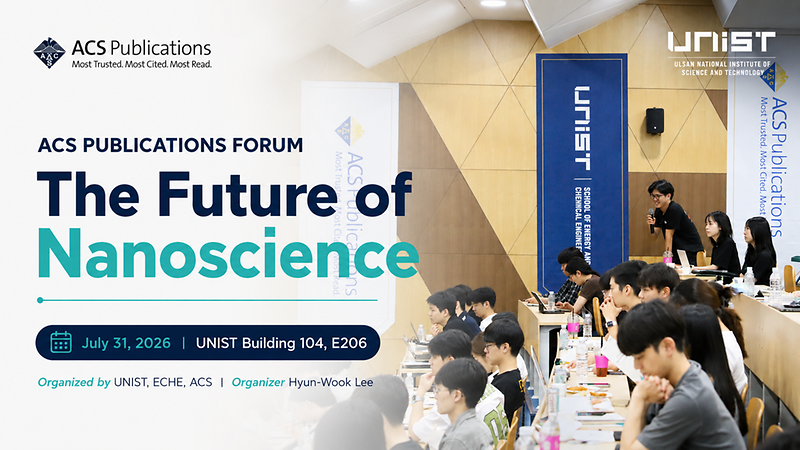
UNIST to Host ACS Publications Forum on the Future of NanoscienceLeading journal editors and early-career researchers exchange ideas on emerging directions in nanoscience.JooHyeon HeoUNIST brought together leading scientific journal editors and early-career researchers on July 31 for the ACS Publications Forum: The Future of Nanoscience , a daylong program focused on emerging research across nanoscience and materials science. Co-hosted by ACS Publications and the UNIST School of Energy and Chemical Engineering, the forum was held under the theme ' ACS Editors' Forum with Early-Career Leaders in South Korea .' The program combined editor sessions, research presentations, panel discussions, and a poster session, creating opportunities for researchers at different career stages to exchange ideas and explore new connections. The forum featured Editor-in-Chief Teri W. Odom of Nano Letters, Editor-in-Chief Xiaodong Chen of ACS Nano, and Editor-in-Chief Suzie Pun of ACS Nano Medicine. Editors from Chemistry of Materials, ACS Nano, and Nano Letters, as well as representatives from ACS Publications, also participated. The afternoon Emerging Scholar Program highlighted research by early-career scientists from UNIST and other universities in Korea. Presentations covered battery chemistry and materials, energy conversion, catalysis, polymer self-assembly, stretchable electronics, optoelectronics, AI sensors, and two-dimensional materials, reflecting the breadth of current research across energy materials, soft matter, and electronics. The program also included a poster session featuring student research. A panel discussion with journal editors provided another opportunity to exchange perspectives on scientific publishing and emerging directions in nanoscience, while networking sessions connected editors, faculty members, and early-career researchers. Organized by Professor Hyun-Wook Lee of the School of Energy and Chemical Engineering at UNIST, the forum was designed to connect established journal editors with emerging researchers and strengthen scientific exchange across the nanoscience community. The event's broader research scope ranged from battery chemistry and energy conversion to stretchable electronics and polymer self-assembly.- 2026.08.06
- 2212
-
News
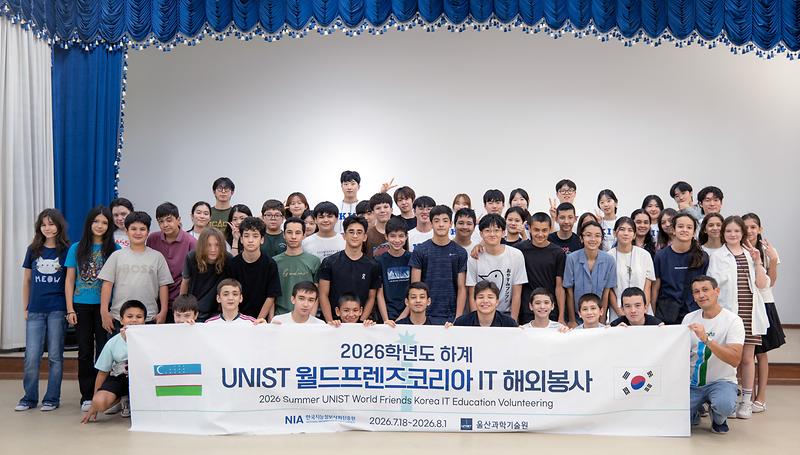
UNIST Students Bring Hands-On STEM Learning to UzbekistanEighteen student volunteers lead STEM projects in AI, renewable energy, engineering, and life sciences for 90 students in Tashkent.JooHyeon HeoFrom solar-powered cars to AI-generated games, students in Tashkent spent two weeks putting science and technology into practice alongside UNIST student volunteers. Eighteen UNIST undergraduates traveled to Uzbekistan for the 2026 Summer World Friends Korea (WFK) IT Education Volunteering Program , designing and leading hands-on STEM lessons for 90 students at Invento The Uzbek International School and Artel Technical School. Held from July 18 to August 1, the program was organized by the UNIST Office of International Affairs with support from the National Information Society Agency (NIA). The volunteers developed their own teaching materials and experiments, drawing on their academic backgrounds and interests. Lessons moved quickly from basic concepts to hands-on design and testing, encouraging students to troubleshoot devices or code and work toward solutions themselves. Working in four teams, the volunteers covered renewable energy, engineering, AI, and life sciences. SolarC explored electricity through fruit batteries, solar-powered cars, and smart-grid simulations, while Team BTS connected physics and coding with Korean culture through traditional games, K-pop, and autonomous vehicles. AIns introduced AI through programmable vehicles and natural-language programming, with students creating their own games and digital content. Hayot , named after the Uzbek word for "life," explored microorganisms, immunity, and vaccines through simulations of infectious disease transmission and prevention. On the final day, participants demonstrated their vehicles, energy systems, and AI projects, explaining the challenges they encountered and how they solved them. “Building and testing a solar-powered car with my friends was the most memorable experience,” said a student from Invento The Uzbek International School. “I learned that science is not just formulas in a textbook, but something we can build and make work ourselves.” Zokhitov Zaylobiddin, Principal of Artel Technical School, said the hands-on activities gave students practical experience with AI, solar energy, and life sciences. “The enthusiasm for learning created by the UNIST students left a strong impression, and we hope these exchanges will continue,” he said. Beyond the classroom, UNIST alumnus Arzubek Murtazaev, originally from Uzbekistan, spoke with students about studying and conducting research in Korea and pursuing careers in science and engineering. Students from UNIST and Uzbekistan also took part in recreational activities together. For the UNIST volunteers, the experience offered a different perspective on teaching abroad. “We were careful not to approach the program simply as people coming to teach,” said Ikjun Seo, a student in the Department of Materials Science and Engineering. "We focused first on building relationships and learning together. That trust helped us work through unexpected challenges as a team." “What made this program meaningful was seeing our students share their knowledge while working alongside local students to find solutions together,” said Young-Bin Park, Dean of Public Relations and International Affairs at UNIST. "We will continue to create opportunities for students to apply their STEM and AI expertise internationally while developing leadership and social responsibility." Building on the program, UNIST plans to expand student-led global outreach that turns undergraduates' academic knowledge into hands-on educational programs developed with schools overseas.- 2026.08.05
- 2847
-
News
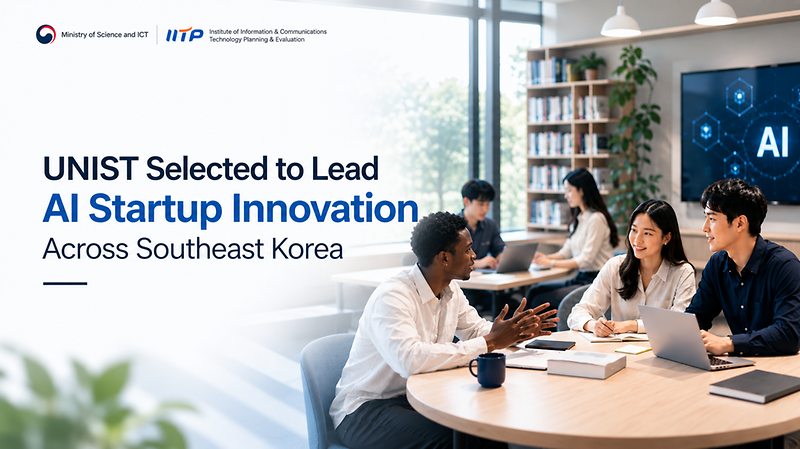
UNIST to Lead AI Startup Innovation Across Southeast KoreaGovernment-backed program will support 180 graduate entrepreneurs while advancing deep-tech innovation across the region.JooHyeon HeoUNIST will lead a new national initiative that brings together researchers, entrepreneurs, and industry to help transform promising AI innovations into new ventures across Southeast Korea. Supported by the Ministry of Science and ICT (MSIT) and the Institute of Information & Communications Technology Planning & Evaluation (IITP), the initiative launched in July 2026 as one of four regional programs selected nationwide. Over the next six years, it will invest KRW 6.05 billion to support 180 master's and doctoral students through mentorship, early-stage funding opportunities, startup guidance, and participation in international startup exhibitions. The project is led by Professor Yong Hwan Kim of the Graduate School of Carbon Neutrality, who also serves as Dean of the College of Engineering at UNIST. UNIST will coordinate the initiative across Southeast Korea, a major manufacturing hub with strengths in automotive, shipbuilding, semiconductors, and advanced materials. By connecting AI research with industry needs, the university aims to bring new technologies to market more quickly. At the heart of the initiative is a ' Market-to-Tech ' model that begins with industry needs rather than existing technologies. Researchers will work alongside companies from the earliest stages of development, developing AI solutions that address real manufacturing challenges while opening new pathways for startup creation. Students will follow a training pathway that combines research, entrepreneurship, and industry collaboration. Existing UNIST programs—including BTS, UIRP, and AICP—will support each stage of the startup journey, from identifying industrial challenges and developing new technologies to validating business ideas and launching new ventures. Beyond supporting individual startups, UNIST aims to strengthen collaboration among universities, industries, and investors across Southeast Korea. The university also hopes successful founders will return as mentors and collaborators, helping foster the next generation of entrepreneurs. “Research has the greatest impact when it begins with the needs of society,” said Professor Yong Hwan Kim. "Working closely with industry gives our students the opportunity to develop technologies with real-world value, while gaining the experience needed to build successful companies."- 2026.07.30
- 3862
-
News
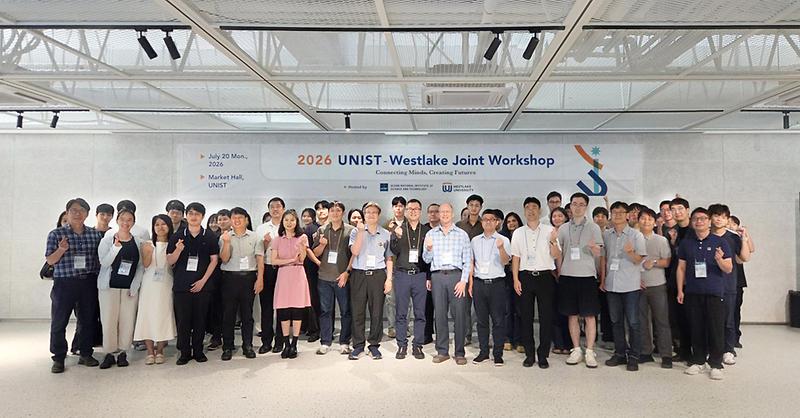
UNIST and Westlake University Expand Research Partnership in Sustainable Energy and Advanced MaterialsThe 2026 UNIST–Westlake Joint Workshop brought together researchers from both institutions to explore future collaborations in catalysis, carbon neutrality, AI-driven manufacturing, and materials science.JooHyeon HeoUNIST has strengthened its research partnership with Westlake University through a two-day workshop focused on sustainable energy, advanced materials, and emerging technologies. Bringing together leading researchers from both institutions, the event provided a platform to exchange recent scientific advances and identify new opportunities for international collaboration. Hosted by the UNIST College of Engineering on July 20–21, the 2026 UNIST–Westlake Joint Workshop featured presentations by 14 faculty members—seven from each university. Discussions spanned catalysis, carbon neutrality, AI-driven manufacturing processes, optical materials, biomaterials, and other areas where the institutions share complementary research strengths. Representing UNIST were Distinguished Professor Rodney S. Ruoff from the Department of Chemistry, Professors Dong Suk Kim and Tae Hoon Oh from the Graduate School of Carbon Neutrality, Professors Kwangjin An and Dongha Kim from the School of Energy and Chemical Engineering, Professor BongSoo Kim from the Department of Chemistry, and Professor Jinhyun Kim from the Department of Materials Science and Engineering. Westlake University was represented by Professors Xiao Yang, Chengchen Guo, Yao Yang, Zexin Jin, Jianbo Tang, Hailin Fu, and Siying Peng. The workshop concluded with a keynote lecture by Jiaxing Huang, Chair Professor in the School of Engineering at Westlake University, titled Innovation Anxiety and the Industries of the Future. An internationally recognized materials scientist and Editor-in-Chief of Accounts of Materials Research, Huang examined how rapid technological advances are reshaping industry and discussed the evolving role of researchers in driving future innovation. "This workshop allowed researchers from both universities to gain a deeper understanding of each other's expertise and explore new directions for collaboration," said Yong Hwan Kim, Dean of the College of Engineering at UNIST. “We look forward to expanding joint research, faculty exchanges, and collaborative programs that build on the strengths of both institutions.” Founded in 2018 in Hangzhou, China, Westlake University is a research-intensive institution with strengths in the life sciences, natural sciences, and engineering. The university is dedicated to advancing frontier research and cultivating the next generation of scientific leaders.- 2026.07.29
- 4059
-
News
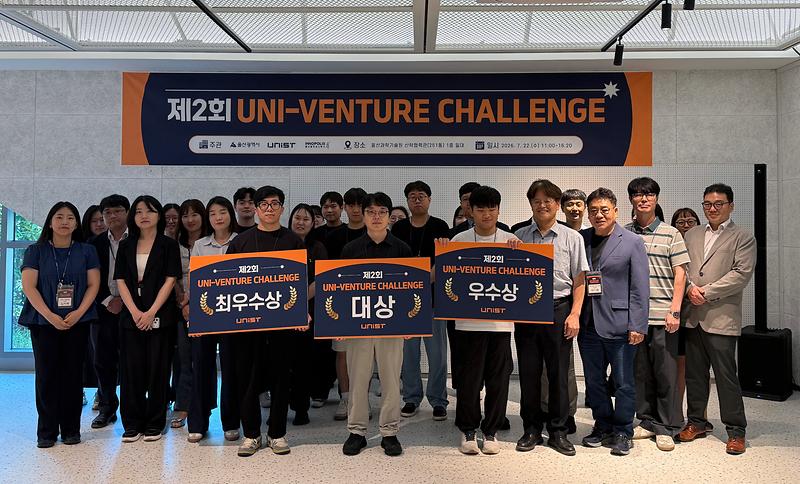
UNIST Provides One-Stop Support for Promising Tech StartupsThe UNI-Venture Challenge featured 13 emerging tech startups, highlighting UNIST's expanding technology commercialization ecosystem.JooHyeon HeoUNIST brought together promising technology startups and venture capital (VC) investors at the 2nd UNI-Venture Challenge on July 22, reinforcing the university's commitment to helping research-based ventures move from innovation to commercialization. The investment pitch competition featured 13 early-stage startups from the Ulsan region, providing founders with opportunities to present their technologies, receive expert feedback, and build relationships with potential investors. More than a pitch competition, the event reflects UNIST's broader approach to entrepreneurship support. Through startup education, mentoring, commercialization assistance, and investor engagement, the university is building an ecosystem that helps technology ventures develop beyond the research stage and prepare for sustainable growth. That effort will enter its next phase in August, when UNIST's Office of University-Industry Cooperation is elevated to the UNIST Venture Foundry. Building on existing entrepreneurship programs, the Venture Foundry will expand support for identifying promising technologies, advancing commercialization, and connecting startups with investors across the Busan-Ulsan-Gyeongnam region. This year's finalists were selected from 28 teams participating in UNIST's entrepreneurship support initiatives. Before the competition, each team received individualized mentoring and pitch coaching to refine its business model and investment presentation. A panel of venture capital professionals evaluated the finalists on technological innovation, market potential, and investment readiness. ANVIX Lab Co., Ltd., led by Professor Hoon Eui Jeong of Department of Mechanical Engineering at UNIST, received the Grand Prize. The Excellence Award went to ELBA Corp., led by CEO Juwon Gu, while Synthkey-Navi, led by Seohyun Choi, received the Merit Award. The program also featured a keynote address by Tae-Gyu Han, Director of UNIST Technology Holdings, on investment trends and startup growth strategies. Throughout the day, participating companies showcased prototypes and met individually with investors to discuss commercialization pathways, investment opportunities, and potential business partnerships. “The UNI-VENTURE CHALLENGE is designed to help promising technologies take the next step toward commercialization by connecting researchers, entrepreneurs, and investors,” said Youngsik Kim, Director of the Office of University-Industry Cooperation. "As the UNIST Venture Foundry expands our entrepreneurship programs across Southeast Korea, we hope to create more opportunities for innovative startups to grow and bring their technologies to market."- 2026.07.27
- 3590
-
News
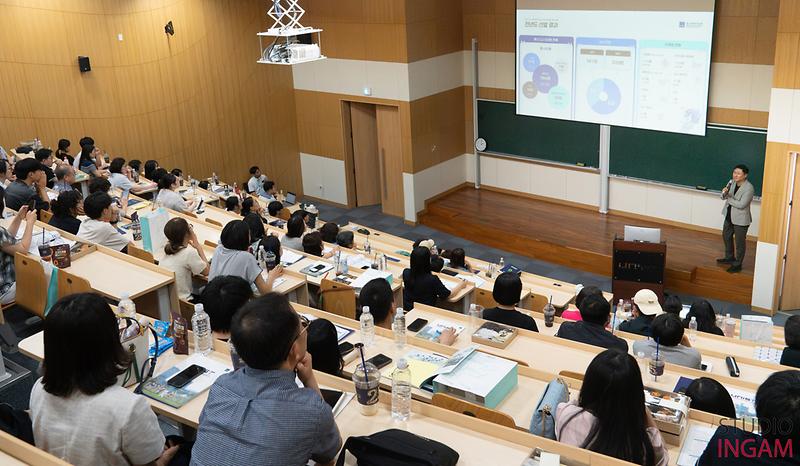
UNIST Showcases New GRIT Program at Open House Ahead of 2027 AdmissionsThe event offered prospective students an early look at student-designed majors and interdisciplinary learning.JooHyeon HeoUNIST offered prospective students and their families a first look at its new School of GRIT Convergence Studies on July 16, ahead of the program's inaugural admissions cycle for the 2027 academic year. Unlike conventional undergraduate programs built around predetermined majors, GRIT will enable students to design their own interdisciplinary fields of study around questions they seek to explore. Approximately 80 students and parents attended the open house at the Business Administration Building. The event introduced the program's educational model and admissions process through an open talk, admissions briefing, Q&A session, and campus tour. During an open talk, Dean Cheol-Min Kim of the School of GRIT Convergence Studies, explained how the program encourages students to begin with questions of their own rather than predefined disciplines. Guided by those questions, students design interdisciplinary academic pathways grounded in science and technology and developed through project-based learning. UNIST also introduced the 2027 GRIT Admissions Track, outlining eligibility requirements, application procedures, document review, and interviews. The university plans to admit approximately 10 students through its 2027 early admissions cycle. Interests extended beyond students preparing to apply in 2027. Many first- and second-year high school students also attended, with questions focusing largely on portfolio preparation, including acceptable materials, formatting, file requirements, and submission guidelines. The program concluded with a campus tour, led by UNI student ambassadors, offering prospective students a firsthand look at the university's academic environment and campus life. “We want students to turn their interests and experiences into questions of their own, then connect those questions with science and technology to create new academic and career paths,” said Dean Cheol-Min Kim. “We hope the open house gave students a practical starting point for exploring their futures and preparing for admission.” Beginning in 2027, the School of GRIT Convergence Studies will offer an undergraduate curriculum centered on student-designed majors and project-based interdisciplinary learning.- 2026.07.24
- 3772
-
News
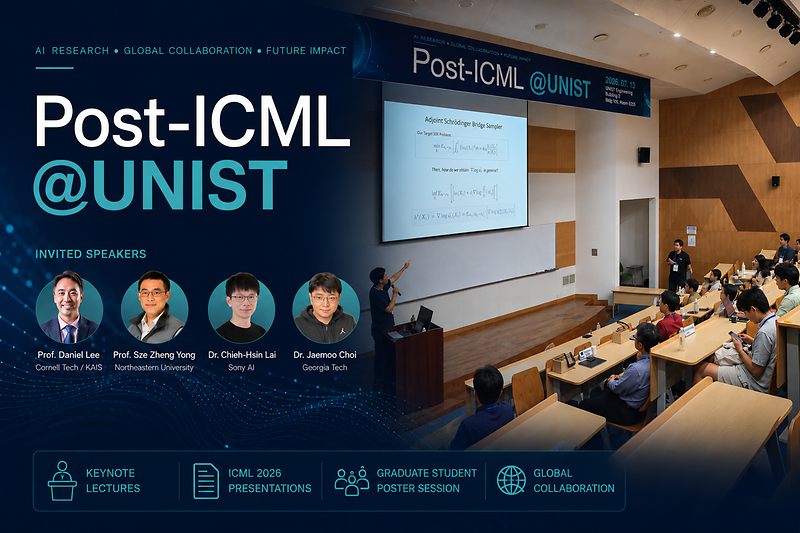
UNIST Brings Global AI Researchers Together at Post-ICML@UNISTInternational scholars and UNIST researchers exchange the latest advances in AI and explore future collaborations.JooHyeon HeoLeading AI researchers from academia and industry gathered at UNIST on July 13 for Post-ICML@UNIST 2026, an international symposium organized by the Graduate School of Artificial Intelligence. The event provided a forum to exchange the latest advances in AI and explore opportunities for future collaborative research. The symposium welcomed researchers visiting Korea for the International Conference on Machine Learning (ICML) , including Professor Daniel Lee (Cornell Tech/Korea Institute for Advanced Study), Professor Sze Zheng Yong (Northeastern University), Dr. Chieh-Hsin Lai (Sony AI), and Dr. Jaemoo Choi (Georgia Institute of Technology), alongside UNIST faculty members and graduate students. Organized by Professors Sangwoong Yoon and Jaejun Yoo, the program featured keynote lectures by invited researchers, presentations of UNIST papers accepted to ICML 2026, and a graduate student poster session. Discussions ranged from emerging AI methodologies to real-world applications across machine learning. The symposium enabled students to discuss their research directly with internationally recognized scholars and gain insight into emerging directions in AI. Faculty members also explored potential directions for future collaborative research with the visiting scholars. The symposium reflects the growing international presence of the Graduate School of Artificial Intelligence. As of June 2026, its researchers had published 15 SCI-indexed journal papers, including 11 papers in the top 10% of Journal Citation Reports (JCR), and 53 international conference papers, 38 of which were accepted to premier AI and machine learning conferences. The school has also recorded 24 domestic and international patent applications and registrations, reflecting continued progress in both fundamental research and technology commercialization. "Post-ICML@UNIST provided a valuable opportunity for our students and faculty to engage directly with leading AI researchers from around the world," said Jae-Young Sim, Dean of the Graduate School of Artificial Intelligence. "We will continue to expand international research partnerships and strengthen UNIST's global leadership in AI."- 2026.07.24
- 3957